Nigeria's Rural Security Crisis: Bandit Attack in Taraba State
Discrepancies in the death toll from a motorcycle assault in eastern Nigeria highlight the ongoing struggle to protect remote communities from armed groups.
By Camila Rodriguez ·
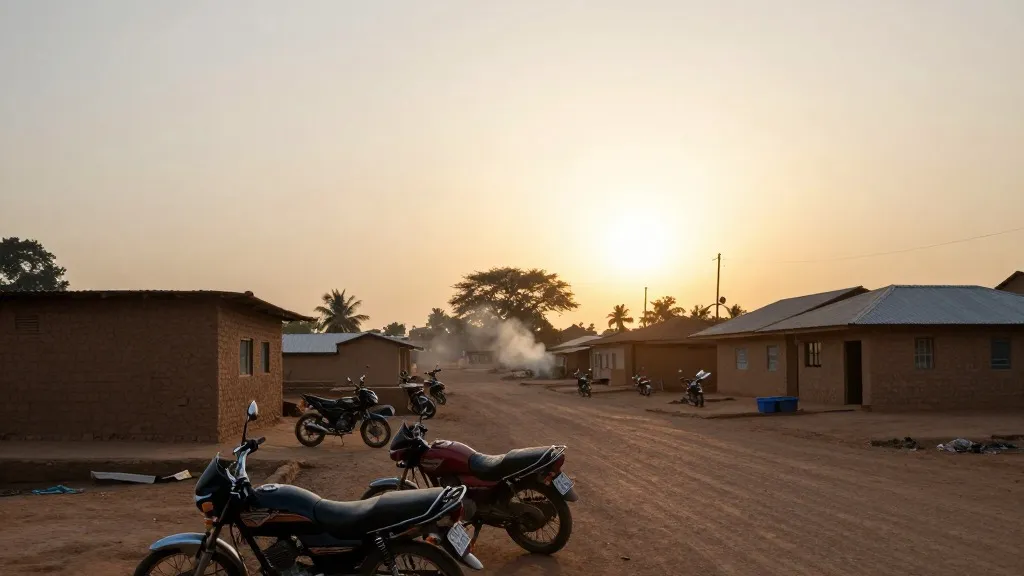
The violence in Binnari village marks a significant escalation in the insecurity affecting rural households in eastern Nigeria. Residents are facing a growing threat from armed groups that operate with little regard for civilian life, often striking during moments of routine community activity. This incident underscores the vulnerability of villages in Taraba State, where the absence of a strong state presence allows such attacks to occur with relative ease, directly impacting the daily safety and livelihoods of local families.
Police officials confirmed on Saturday that at least ten bodies had been recovered by Friday evening following the assault. The attackers, described as a large group of gunmen riding motorcycles, targeted the village in Taraba State. During the raid, officers noted that the assailants looted food supplies from local shops, a pattern that suggests the attacks are often motivated by the seizure of resources rather than ideological goals.
However, the official police figures appear to be a conservative estimate compared to other reports from the ground. Survivors provided accounts to the AFP news agency stating that the death toll reached at least twenty individuals. The human rights organization Amnesty International issued a statement on Saturday claiming that forty people were killed in the attack. The group noted that while police initially confirmed ten deaths, additional bodies were discovered later in the day on Saturday, suggesting the true cost of the violence may be higher than the initial official count.
Community members described the timing of the attack as particularly devastating, with gunfire erupting just after Friday prayers. Sa'idu Nuhu, a resident of Binnari, stated that after the attackers withdrew, the community counted more than twenty bodies, with several individuals still missing. Another resident, Isiyaku Musa, corroborated these figures, placing the death toll at no fewer than twenty. These personal testimonies paint a picture of a sudden and chaotic disruption of normal life.
Local leadership provided further details on the scale of the operation. Malam Abubakar Saifullahi, a community leader, explained that the assailants arrived on approximately fifty motorcycles, with two men riding on each bike. He described how the group systematically raided the village, taking cash, foodstuffs, and other provisions. The attackers also seized motorcycles that residents had abandoned while fleeing the scene, leaving the community with fewer means of transport and trade in their aftermath.
The incident has drawn sharp criticism from international observers regarding the Nigerian government's response. Amnesty International stated that authorities continue to leave rural communities in parts of the north at the mercy of gunmen who commit atrocities with impunity. This critique highlights a broader concern that remote areas are often neglected in national security strategies, allowing banditry to flourish in regions where police and military forces are overstretched.
Banditry has emerged as a major challenge in northwest and central Nigeria, where powerful gangs frequently clash with security forces. Taraba, located in the central-eastern region, is also a hotspot for these non-ideological groups. These bands typically raid villages, kidnap citizens for ransom, and impose informal taxes on farmers and miners in areas where the state has limited reach. This persistent instability complicates economic activities and forces rural populations to live under a constant state of alert.
The broader security landscape in Nigeria remains tense, with the country continuing to fight an armed rebellion that began with the Boko Haram uprising in 2009. In a separate development on the same day, the Nigerian military announced that it had killed fifteen terrorists in an air strike in the northeastern state of Borno. This simultaneous action in the northeast and the bandit attack in the east illustrate the multi-front nature of the country's security challenges, requiring coordinated responses across different regions.
Looking ahead, the discrepancy in death tolls and the scale of the attack may prompt a renewed assessment of security deployments in Taraba State. The military and police will likely need to address the specific tactics used by these motorcycle-borne gangs, which allow them to strike quickly and retreat into the bush. For the people of Binnari, the immediate focus will be on recovering the missing and securing their food supplies, while the wider community awaits clarity on the final number of victims.
Source: Al Jazeera