Lunar Settlements May Lack Essential Water
New research indicates that the moon's limited water reserves could restrict long-term human habitation to small populations unless extraction methods improve significantly.
By Marcus Johnson ·
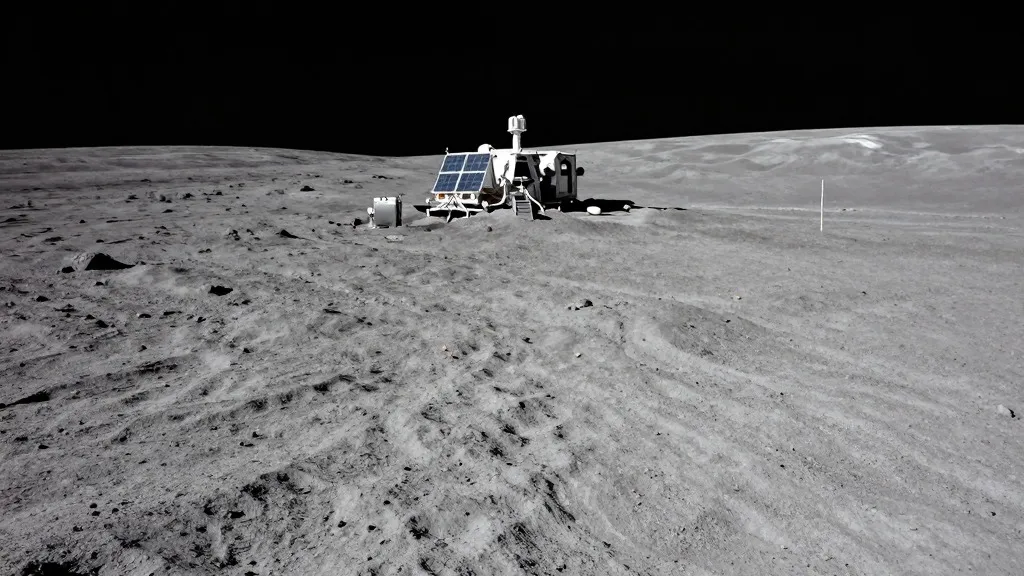
The dream of vast lunar metropolises may be hitting a hard physical limit.
Prominent tech leaders have recently painted a bold picture of the future. In February, Elon Musk, the chief executive of SpaceX, stated on social media that the company had pivoted its primary focus from Mars to constructing a self-growing city on the moon. He suggested this goal could be met in less than a decade, a timeline significantly shorter than the two decades previously associated with Mars colonization. Jeff Bezos, the head of Blue Origin, has made similar claims, predicting that millions of humans will reside in space by 2045.
These ambitious projections prompted a critical review by two academics who decided to test the feasibility of such large-scale settlements against actual data. Martin Elvis, a senior astrophysicist at Harvard University's Smithsonian Astrophysical Observatory, collaborated with Jonathan McDowell, an honorary professor at the Durham University Space Research Centre in England. Their analysis, published in the journal Frontiers in Space Technologies, examines two critical resources required for survival: power and water.
The findings suggest that energy generation is not the primary bottleneck. The researchers determined that a combination of solar and nuclear power sources would be sufficient to sustain a population of one million people on the lunar surface. The challenge lies in the availability of water, a resource that is far more constrained than the energy supply.
Water does exist on the moon, with the majority believed to be located in permanently shadowed regions near the poles where sunlight does not penetrate. Current estimates suggest there is roughly one billion tonnes of this resource. However, the study calculates that a population of one million people could consume this supply in approximately 100 years. This projection assumes a water recycling rate of 98 per cent, which matches the efficiency currently achieved on the International Space Station.
Martin Elvis argued that while one billion tonnes is a large number, it is modest when viewed in the context of a major city's needs. He used an analogy to explain the scale, comparing the total amount to an aquarium the size of Central Park filled until the Statue of Liberty is just underwater. He described it as a small lake, noting that such a volume is unlikely to support a large city for an extended period.
Smaller communities present a more sustainable option. Under the same assumptions, a town of 10,000 people could last for centuries. Jonathan McDowell noted that if the goal is to cover the lunar surface with cities as depicted in science fiction, new methods must be found to transport water to those locations, as it is not currently available in sufficient quantities everywhere.
The assumptions used in the study may even be optimistic. Elvis suggested that the estimate of one billion tonnes is likely 20 or 30 times too high. He further noted that only one-third to one-half of the existing water might be recoverable. His best estimate is that the usable amount is about one per cent of the original figure, which would reduce the sustainable lifespan of a million-person settlement from 100 years to just one year.
There is also uncertainty regarding the physical state of the water. Gordon Osinski, a professor of planetary geology at Western University in London, Ontario, pointed out that satellite measurements contain uncertainties. He believes the water is present but requires confirmation from the ground. He suggested it might resemble Arctic permafrost, consisting of sub-millimetre ice crystals mixed into soil, which would be difficult to extract.
Despite the constraints, McDowell emphasized that the findings should not be viewed as a reason to abandon lunar ambitions. He stated that the truth is never negative, and that it is more problematic to attempt something that is destined to fail than to understand the limitations first.
Source: CBC News